 August 27, 2026
01News
SoliTek Achieves Cradle to Cradle Certified® Full Scope Silver

SoliTek’s new solar module portfolio, produced on its fully upgraded manufacturing line, has achieved Cradle to Cradle Certified® Full Scope Silver under the new Version 4.1 standard.
This makes SoliTek the only PV manufacturer in the world to hold this level of Cradle to Cradle certification.
Sustainability across the full lifecycle
Solar modules are typically compared on power output, efficiency, degradation, and mechanical performance. But a comprehensive sustainability also depends on how a module is made, what it contains, and whether those materials can be recovered after decades of use. Full Scope certification assesses all of this together, supporting SoliTek's strategy of durable glass-glass construction and circular design.
"Our goal is not only to manufacture high-performance solar modules, but to consider their environmental and social impact throughout the complete lifecycle," said Julius Sakalauskas, CEO of SoliTek. "Being the only PV manufacturer in the world currently holding this level of certification is a significant achievement for our team and partners."
Built for the long term
Durability reduces premature replacement and lowers raw material use over a system's lifetime. SoliTek's modules are designed for rooftop, building-integrated, facade, carport, and ground-mounted applications, combining mechanical strength and environmental resistance with built-in circularity.
Why this matters now: tightening EU requirements
People considering solar aren't just choosing certification for its own sake - the EU regulatory landscape is moving in this direction anyway, and getting ahead of it has real practical value:
- Ecodesign for Sustainable Products Regulation (ESPR): This framework regulation entered into force on July 18, 2024, and extends eco-design requirements beyond energy-related products to virtually all products placed on the EU market, including components and intermediate products. Panels are explicitly named as a priority category, with a transition period running until December 31, 2026, after which new eco-design measures are expected to apply. A central pillar is the Digital Product Passport - every covered product will need one, opening up data on materials, origin, and environmental impact to businesses, consumers, and regulators alike. SoliTek solar panels have already obtained digital product passports. UL Solutions + 3
- Net-Zero Industry Act (NZIA): Adopted in May 2024, the NZIA sets a binding target for 40% of the EU's annual net-zero technology deployment needs - including solar - to be produced domestically by 2030.
Beyond manufacturing targets, it directly shapes how PV modules get sold into public projects: under an implementing regulation that came into force on 18 June 2025, authorities running renewable energy auctions must now weigh sustainability, resilience, cybersecurity, and responsible business conduct alongside price, applying these criteria to at least 30% of annual auctioned volume (or 6 GW) per country.
Carbon footprint performance is expected to be a key minimum environmental criterion for PV modules in public procurement, alongside technical durability requirements under the NZIA's Implementing Act. Net Zero Compare + 3 - Carbon footprint thresholds: Regulators are also moving toward hard limits on embodied carbon.
France's public tender criteria already cap PV carbon footprint at 550 kgCO2eq/kW, and the EU's Joint Research Centre has proposed harmonized rules for calculating PV carbon footprint to inform future mandatory Ecodesign requirements. SoliTek’s carbon footprint is comfortably within the set limit, at 526 kgCO2eq/kW. ScienceDirectEuropean Commission
Clients who choose certified modules today get a head start on compliance and a stronger position in public auctions and procurement, rather than scrambling once these rules take full effect.
Why it matters to clients
Beyond regulation, the certification removes the guesswork from sustainability claims generally. Rather than taking a manufacturer's word for it, clients get independently verified proof of how a module is made, what it's made of, and how it will perform and age over time.
This matters most for projects seeking green building certifications, ESG reporting credentials, or procurement standards that demand verified supply-chain accountability — and it gives clients documentation they can point to as due diligence, both for today's voluntary sustainability goals and tomorrow's mandatory EU rules.
E.g., for selecting Made-in-EU SoliTek production, developers can receive 7 extra points in the LEED program, 5 extra points in the WELL program, and 2 credits in the BREEAM program.
02More news
 May 04, 2026
SoliTek Modernized European Facility Reaches Full Operational Capacity
After successfully commissioning its upgraded manufacturing line this past winter, SoliTek announces that the facility is now fully operational and producing at full scale. This modernization marks a significant step for European PV manufacturing, reflecting the company’s strategic objective to increase efficiency and support next-generation technology while maintaining a strictly local production footprint.
 April 22, 2026
SoliTek Strengthens Italian Offering with ENEA and Fire Class Updates
New SoliTek Modules Added to the ENEA Register: BLACKSTAR 455 W – residential solution with 22.77% efficiency and MAGNUS 510 W – high-performance module for commercial & industrial projects with 22.93% efficiency.
 April 22, 2026
Investment support for individual electricity storage devices
UAB „Soli Tek Cells“ is implementing project No. 03-009-J-0001-J06-00182 under the joint project call "Investment support for individual electricity storage devices." During the project, a storage unit with a capacity of 500.00 kWh will be installed.
 February 10, 2026
SoliTek advances European modules with efficiency up to 22.93%
SoliTek updates its EU-made modules with higher power and improved efficiency, allowing the same capacity with fewer panels. The upgrade supports streamlined installation and reduced balance-of-system needs, accompanied by a transition in glass technology. The higher power ratings allow increased energy generation from the same roof area without expanding the physical footprint of the installation.
 November 17, 2025
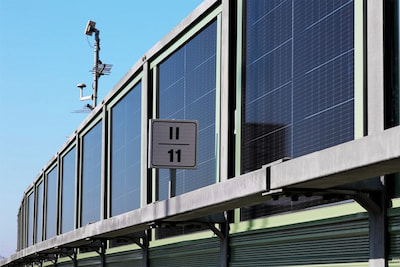
SoliTek Photovoltaic Noise Barrier Installed in Italy
A new solar-integrated noise barrier pilot has been completed along the E80 highway near Rome, adjacent to the ANAS Smart Road Center, incorporating high-efficiency bifacial photovoltaic modules supplied by SoliTek. The installation, developed by ANAS in cooperation with GSM Continental as the main contractor, demonstrates how sound-mitigation structures can also contribute to renewable energy generation.